GCSE data
Which GCSE subjects awarded the most grade 9s in 2026?
Among the 39 subject categories in JCQ's England GCSE results table for summer 2026, Science: Double Award had the lowest Grade 9 percentage (1.14%), followed by English Language (2.25%). At the other end, Classical Greek (55.43%) had the highest Grade 9 percentage, but only 828 entries. Chemistry recorded 14.73% Grade 9 from 159,731 entries, compared with English Language's 2.25% from 819,199 entries.
These are percentages of exam entries, not pupils. A low or high Grade 9 share does not establish which GCSE is hardest or easiest: subject cohorts, entry patterns, qualification structures and selection differ.
Visual comparison: Grade 9 shares in major subjects
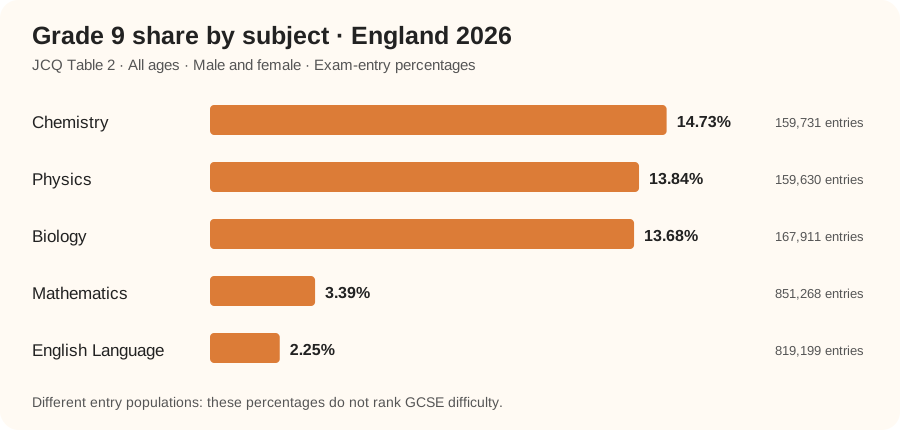
Lightbulb Learning chart from JCQ 2026 Table 2, England, all ages, male and female. Each percentage is a share of subject exam entries, not a pupil's probability of receiving Grade 9.
The lowest Grade 9 shares
| Subject/category | 2026 entries | Grade 9 share 2026 | 2025 share | Change, percentage points | |---|---:|---:|---:|---:| | Science: Double Award | 942,776 | 1.14% | 1.12% | +0.02 | | English Language | 819,199 | 2.25% | 2.30% | −0.05 | | Engineering | 2,051 | 2.73% | 2.39% | +0.34 | | Citizenship Studies | 21,506 | 2.78% | 2.65% | +0.13 | | Mathematics | 851,268 | 3.39% | 3.18% | +0.21 | | English Literature | 613,440 | 3.41% | 3.60% | −0.19 | | Sociology | 30,902 | 3.44% | 3.50% | −0.06 | | Media Studies | 27,513 | 3.59% | 3.73% | −0.14 | | Business Studies | 139,284 | 3.70% | 3.87% | −0.17 | | Psychology | 20,534 | 3.88% | 3.75% | +0.13 |
Combined Science caution: 'Science: Double Award' is a double-award category, not directly comparable to separate single GCSE science subjects. Report its position in the official category table, but exclude it from any ranking explicitly restricted to single-award GCSEs. English Language is the lowest listed single-award category in this table.
The highest Grade 9 shares
| Subject/category | 2026 entries | Grade 9 share 2026 | 2025 share | Change, percentage points | |---|---:|---:|---:|---:| | Classical Greek | 828 | 55.43% | 52.07% | +3.36 | | Other Modern Languages | 40,437 | 41.03% | 40.55% | +0.48 | | Latin | 7,751 | 36.32% | 34.52% | +1.80 | | Electronics | 668 | 32.93% | 39.84% | −6.91 | | Geology | 422 | 26.54% | 25.29% | +1.25 | | Biblical Hebrew | 636 | 19.03% | 18.72% | +0.31 | | Chemistry | 159,731 | 14.73% | 14.77% | −0.04 | | Physics | 159,630 | 13.84% | 13.85% | −0.01 | | Biology | 167,911 | 13.68% | 13.05% | +0.63 | | Classical Civilisation | 4,582 | 11.85% | 12.58% | −0.73 |
Grouping caution: 'Other Modern Languages' is a category grouping, not one language subject. Small-entry subjects (for example Geology and Classical Greek) can be highly selected; their percentages are not representative of a typical pupil's chance of achieving Grade 9.
How do the three separate sciences compare?
Chemistry 14.73% (159,731 entries), Physics 13.84% (159,630), Biology 13.68% (167,911). All are higher than Mathematics 3.39% and English Language 2.25%. This does not mean science is easier: entry into separate sciences differs markedly from entry into compulsory English and maths.
Why do separate sciences award a higher share of Grade 9s?
Separate Biology, Chemistry and Physics entries are not drawn from the same pupil population as compulsory English Language and Mathematics. The observed shares partly reflect who takes each qualification, so the differences cannot establish that science papers are easier. Combined Science double award is also a different qualification structure and should not be directly ranked against single-award sciences.
Is Classical Greek the easiest GCSE because it has the most Grade 9s?
No. Its 55.43% share came from only 828 entries, a small, highly selected cohort. The statistic describes grades awarded to that cohort; it does not measure intrinsic subject difficulty or predict an individual student's outcome.
How did Grade 9 shares change since 2025?
In the matched JCQ categories, Biology rose from 13.05% to 13.68% (+0.63 percentage points), while Chemistry moved from 14.77% to 14.73% (−0.04 points). These are changes in the proportion of entries awarded Grade 9, not changes in examination difficulty. See the comparison tables above for the other listed categories.
Why a Grade 9 percentage is not a 'hardest subject' ranking
The share of entries awarded a top grade depends partly on which students take the subject. Subjects are not randomly assigned. Some are compulsory, some optional, and some attract small, specialised cohorts. A Grade 9 percentage cannot isolate intrinsic difficulty, teaching quality or a pupil's likely result.
Sources and methodology
- Source: JCQ, GCSE results — June 2026, Table 2, 'GCSE results by main grades, subjects, age and sex, England, 2026'; official workbook supplied by owner. Cover sheet publication date: 20 August 2026.
- Filters: Category GCSE; Year 2026; Location England; Age All ages; Sex Male and Female; exclude aggregate 'All subjects'. 39 subject/category rows, summing to 5,719,406 entries, exactly matching the 'All subjects' row in this JCQ table.
- Measure: Column '9 %', non-cumulative percentage of subject exam entries awarded Grade 9; do not use '8 and above %' or '7 and above %'.
- 2025 comparison: matched the same subject/category labels in the 2025 rows of the same workbook with identical location, age and sex filters; 39 matched categories. Changes are 2026 minus 2025 in percentage points.
- Rounding: source rates rounded to two decimal places for display; changes calculated from unrounded source percentages then rounded to two decimal places. Minor displayed subtraction discrepancies can result from rounding.
- Limitations: 'Science: Double Award' and 'Other Modern Languages' are distinct category types; all-age exam entries are not unique pupils. Some subject cohorts are small; this is descriptive, not causal.
- SEO positioning: distinct from How rare is a Grade 9 GCSE?, which measures overall Grade 9 rarity and straight 9s, not a complete subject comparison. Relevant UK search estimates: 'hardest gcse subjects' 260/month; 'easiest gcse subjects' 390/month (DataForSEO Google Ads, October 2026). Those queries are answered with methodological caveats, not misleading labels.
Turn tonight’s topic into a real revision session.
Lightbulb builds notes, flashcards, a quiz and a marked exam question from whatever your child covered in class today — matched to their exam board. When full access opens, your first 3 sessions will be free.
Join the waitlist →